What is the Global Gateway?
Myth versus truth — and the history of how a continent was divided into corridors.
Launched in 2021, the EU and its member states positioned the Global Gateway as a "joint Western alternative" to counterbalance China's Belt and Road Initiative. But this framing was quietly dropped in 2025, once it became clear the comparison did not hold.
On paper the Gateway is a partnership informed by Africa's needs, flowing from a joint AU–EU Strategy and Agenda 2063 — "smart, clean and secure links" in digital, energy and transport, held to the highest social and environmental standards, with a civil-society advisory board to guard its values.
A 2020 report by the German Institute of Development and Sustainability (DIE) gives a candid account of the gap between the EU's public face and its private practice: development aid instrumentalised to pursue European economic and security interests.
The Global Gateway takes this to its highest level. It is a tool to secure Europe's grip on Africa through skewed long-term extraction contracts, unsustainable debt, and energy and infrastructure deliberately structured to serve European industries.
Dividing Africa into corridors
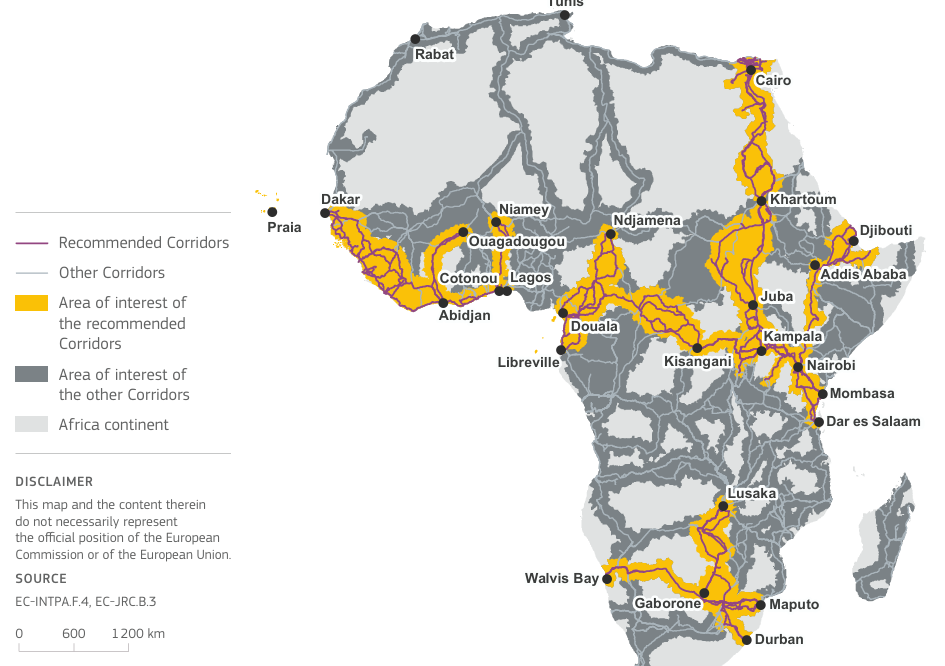
The history of the Global Gateway in Africa begins not with a summit but with a map. Before the initiative was announced, the European Commission ran a project called Corridors and Urban Systems in Africa — CUSA — which mapped the continent along its resource paths.
Carried out in two phases, the mapping narrowed an initial field of 55 potential passageways down to a shortlist of eleven strategic corridors, using 140 quantitative indicators and four policy scenarios: Europe–Africa connectivity; human development, peace and security; the Green Deal; and sustainable growth.
Some of those indicators are telling. They measured how much a region trades with the EU; the estimated availability of mineral resources; the share of each corridor projected for agriculture by 2050; World Bank versus Chinese financing between 2004 and 2014; connections between corridor ports and EU ports; and violent events and demonstrations between 2015 and January 2021.
Africa — the EU's close neighbour — is a continent full of opportunity … the EU should make the most of the political, economic and investment opportunities … through partnerships that uphold and promote European values and interests.— The CUSA Report
The corridors were evaluated against criteria defined jointly by DG INTPA and the Joint Research Centre — with no input from, or awareness by, Africa. The eleven were formally unveiled in the conclusions of the EU–African Union Summit of 17–18 February 2022.
A European juggernaut, negotiating one country at a time
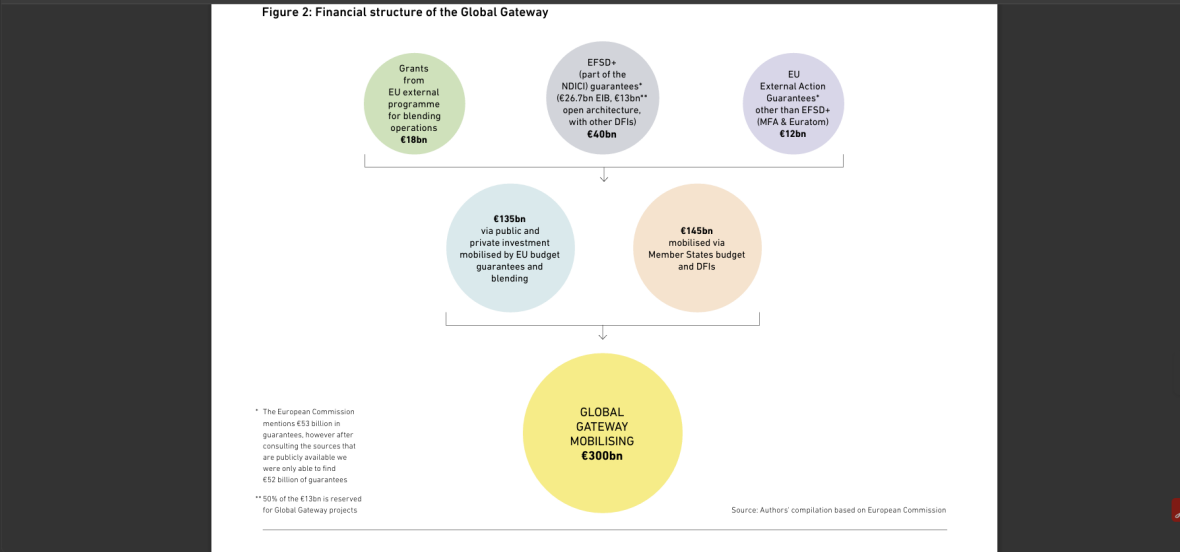
In 2022 the EU announced an investment package of $346.03 billion, of which $173.017 billion was earmarked for Africa between 2022 and 2027. The announcement was misleading. The G7 had just launched the Partnership for Global Infrastructure and Investment (PGII) — a repackaging of Build Back Better World — and the Gateway became Europe's contribution. But none of the G7 actors were putting in new resources: they were repackaging existing loans and guarantees.
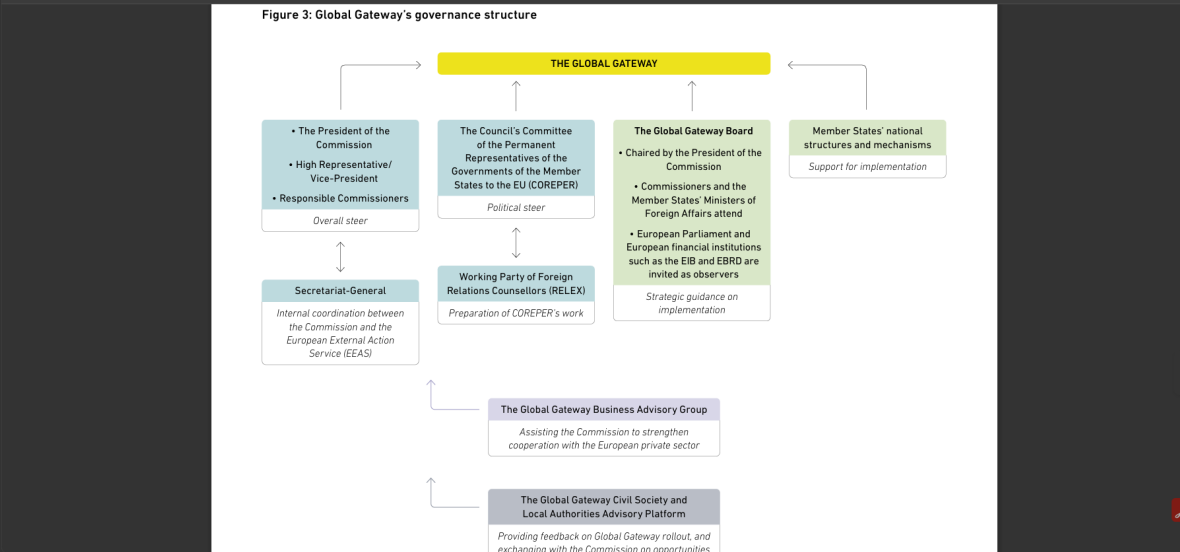
To exploit the leverage of individual member states, the EU adopted Team Europe — pooling political, financial and diplomatic muscle into a single wall. The consequence is an asymmetry of power: a single African country negotiates one project at a time against a European bloc of roughly $21 trillion in nominal GDP.
Ownership by consultation — with politicians only
The EU insists that every project results from long consultations with partner governments. In practice, member states bring their own projects and negotiate them with politicians — often under secrecy. A review of roughly 300 Global Gateway projects across Africa found not a single one debated or approved by a national parliament, or shared with citizens for public participation.
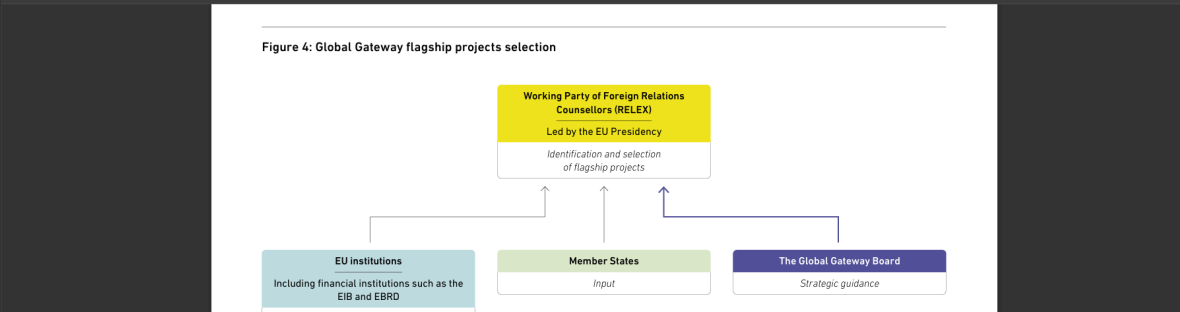
Projects are negotiated individually between Team Europe and partner-country politicians, and kept confidential until a final agreement is reached — limiting scrutiny during development.
The EU avoids framing the Gateway as financial competition with China, preferring a collaborative, values-based posture that discourages financial comparison and adds to the opacity.
"Consultation" means the executive branch alone. Of roughly 300 projects reviewed, not one had been debated by a parliament or shared with citizens.
Projects are chosen to entrench trade and investment rules that protect Europe's competitiveness — not to industrialise partner economies. Technology transfer and IP are kept off the agenda.
The hydrogen myth
The hype around green hydrogen risks increasing reliance on fossil gas. Renewables-based hydrogen production remains minimal — less than 0.1% of global hydrogen in 2022, according to Corporate Europe Observatory — and an expensive, energy-intensive solution that concentrates benefits with a handful of large companies while consuming land, water and renewable capacity that partner countries need locally.
The emphasis on green hydrogen projects, influenced by the EU Global Gateway, raises fears of exploitation and the creation of sacrifice zones.
What internal documents reveal the EU is really after
The "360-degree approach": pair hard infrastructure with sectoral reforms and a regulatory environment favourable to European companies over the long term.
Loans and guarantees that lock partner states into repayment while opening their markets to European primes.
A single Global Gateway brand and campaigns with local influencers in local languages — "campaigning to people rather than governments."
Team Europe pools weight: the EU and its members account for ~30% of all UN funding, 25% of the World Bank's capital and 33% of the IMF's assets.
Use Team Europe to structure normative engagement abroad and "promote our core internal policies."
Africa holds 60% of the world's best solar resources and over 70% of global cobalt, yet draws only 2% of clean-energy investment. "Europe needs Africa as much as Africa needs Europe."
Concentrate on flagships — vaccines in Rwanda, Senegal, Ghana and South Africa; raw-materials value chains in Zambia, DRC and Rwanda; green hydrogen in Namibia and Mauritania; and the Lobito Corridor.
Sold as China's mirror — but a different instrument entirely
| China · Belt & Road | EU · Global Gateway | |
|---|---|---|
| Funding structure | Investment fund, initially projected at $4T; over $1T committed by 2025. | Loans and loan guarantees; the $317B headline includes projects already in flight before GG existed. |
| Areas of interest | Silk Road Economic Belt and 21st-Century Maritime Silk Road across Europe, the Middle East, Central Asia, Asia and Africa. | Infrastructure, energy and critical minerals along 11 CUSA-mapped strategic corridors in Africa. |
| Primary beneficiary | China — the entire belt orients movement of goods and materials toward China. | Europe — but with 'conduit' geographies. Cobalt processing still runs through China and Gulf states (UAE, Qatar). |
| Repayment burden | Direct project debt to Chinese lenders. | Sovereign debt and PPP concessions carried by African governments, guaranteed against European risk facilities. |
| Programming ownership | Bilateral, Beijing-led. | Team Europe — the Commission, member states and their DFIs coordinate as a single bloc. |
Boston University's Chinese Loans to Africa database records 1,188 Chinese loan commitments totalling $160 billion between 2000 and 2020. Against that scale, the Global Gateway is best understood not as a separate pot of new aid, but as a reframing and consolidation of European development finance.