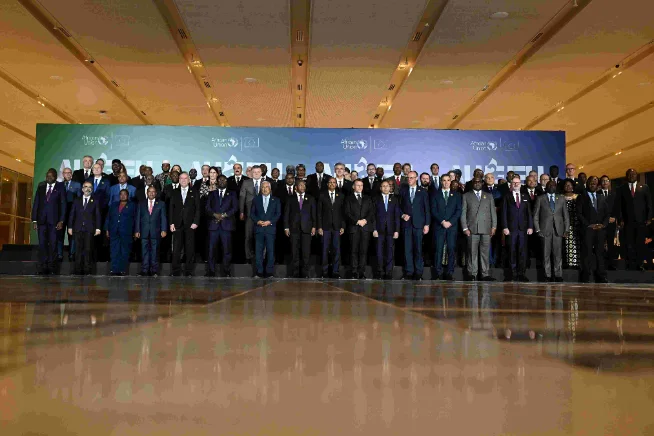
Officials hold signed agreements at the Global Gateway Forum 2023 against the Global Gateway backdrop
The brief · 2026

Sharing the continent one more time.

From Berlin 1885 to Brussels 2022

Read the General Act of the Berlin Conference (1885).

Global Gateway Forum 2023 — partnership agreements held up for the cameras.

$724B

Estimated African debt exposure created across the Global Gateway corridors by the time the Global Gateway comes to a close in 2027, if it ever will

55 → 11

Africa partitioned into 11 Corridors shortlisted by the EU's Urban Systems in Africa (CUSA) Corridor mapping, from 55, using 140 indicators.

≈300 / 0

Global Gateway projects signed between Team Europe and African political elite — none of which has been approved by a national parliament or opened to public participation.

Berlin → Brussels

One partition, two centuries

1885 · Berlin

On February 26 1885 European countries, sitting in Berlin, agreed to the General Act of the Berlin Conference on West Africa, with 39 Acts that divided Africa into 54 countries with its resources as the parameter.

2022 · Brussels

On February 18 2022, European countries, sitting in Brussels, agreed to the Global Gateway with 149 indicators that divided Africa into 55 Corridors that have now been narrowed down to 11, with Critical Minerals and other resources as the parameters.
1885 · Berlin

On February 26 1885, it was United Kingdom, France, Germany, Austria, Belgium, Denmark, Spain, the United States of America, Italy, the Netherlands, Portugal, Russia, Sweden-Norway, and Turkey (Ottoman Empire).

2022 · Brussels

On February 18 2022 it was Team Europe — all the 27 European Countries, their Banks, and their leading corporations.

1885 · Berlin

On February 26 1885 they signed to take away resources out of Africa.

2022 · Brussels

On February 18 2022 they signed to not only take away the resources, they also take away logistical routes and all gateways out of Africa — the ports, the rails, the pipelines — and will leave the continent with a massive $724 billion in debt to pay over the next 50 years, while contracts and refining capacity stays outside the continent.

1885 · Berlin

On February 26 1885 Africans were not even aware they were being partitioned.

2022 · Brussels

On February 18 2022 African politicians and its Banking elite cheered on over Champagne, hailing new “partnerships” under what they call Africa-Europe Investment Package that will ostensibly support the creation of strategic, sustainable and secure transport corridors and support value chains, services and jobs that can benefit industries in both Africa and Europe.

But like 1885 African citizens were not involved, or even made aware what their politicians were signing away to Europeans.

The myth

Launched in 2021, the EU and its member states positioned the Global Gateway as a "joint Western alternative" to counterbalance China's Belt and Road Initiative. But this framing was quietly dropped in 2025, once it became clear the comparison did not hold.

On paper the Gateway is a partnership informed by Africa's needs, flowing from a joint AU–EU Strategy and Agenda 2063 — "smart, clean and secure links" in digital, energy and transport, held to the highest social and environmental standards, with a civil-society advisory board to guard its values.

The truth

A 2020 report by the German Institute of Development and Sustainability (DIE) gives a candid account of the gap between the EU's public face and its private practice: development aid instrumentalised to pursue European economic and security interests.

The Global Gateway takes this to its highest level. It is a tool to secure Europe's grip on Africa through skewed long-term extraction contracts, unsustainable debt, and energy and infrastructure deliberately structured to serve European industries.

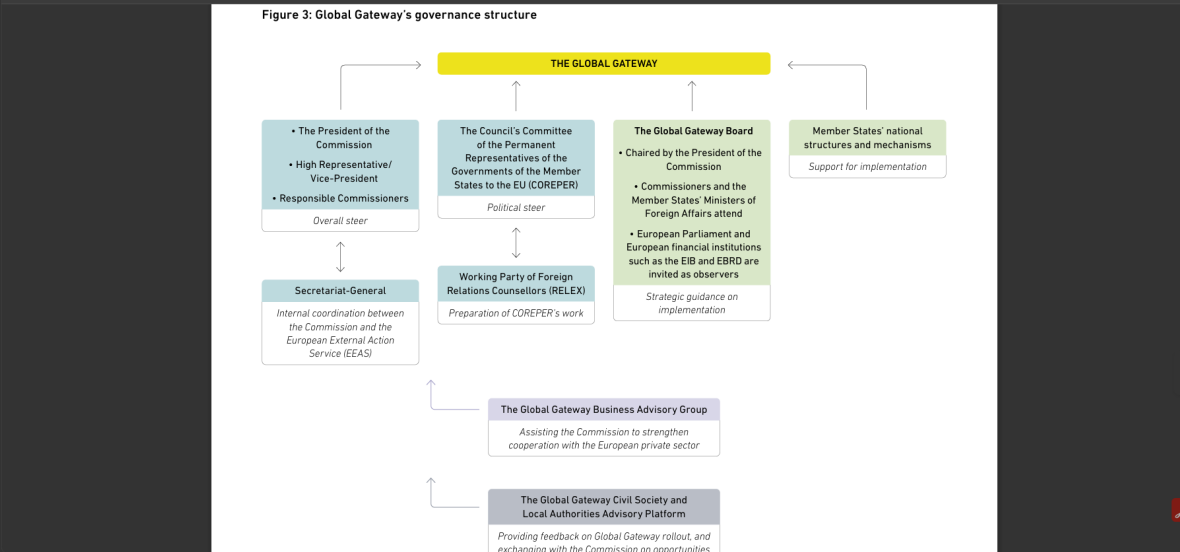
Global Gateway governance structure
Global Gateway's governance structure — European institutions and Member States hold the steer. Source: Counter Balance / Eurodad / Oxfam.
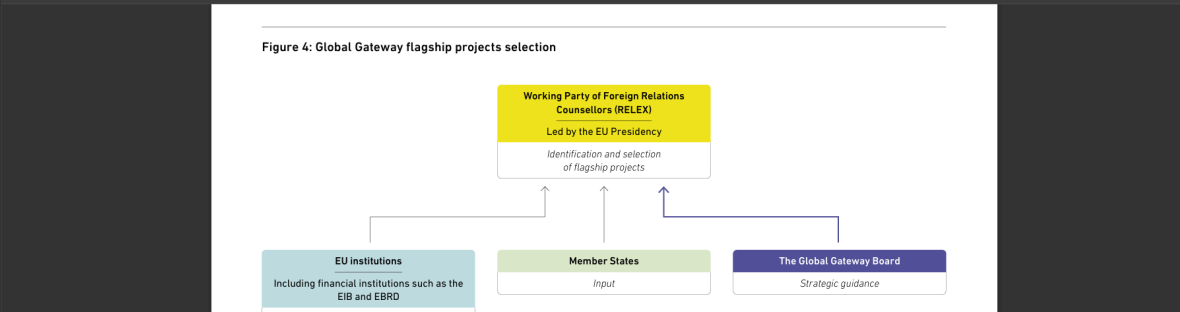
Global Gateway flagship project selection
Flagship projects are identified and selected by RELEX under the EU Presidency. Source: Counter Balance / Eurodad / Oxfam.

Browse the EU's official flagship shortlists for 2023–2026 — titles, countries and sectors, without leaving this site: Global Gateway flagship projects.

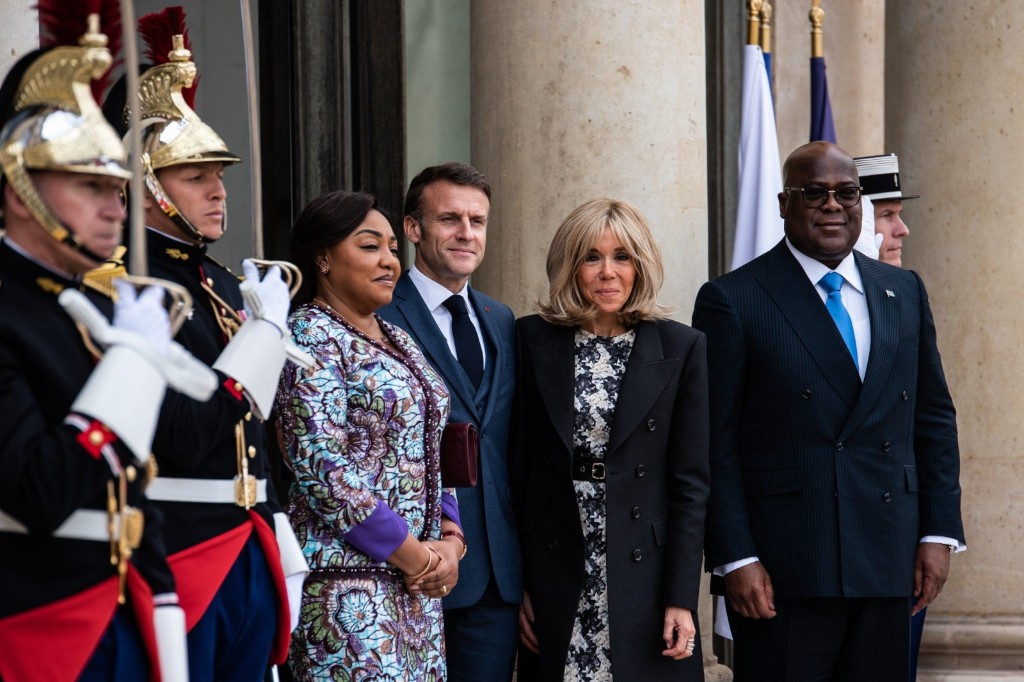
Emmanuel Macron and Félix Tshisekedi with their spouses at the Élysée
History · CUSA

Dividing Africa into corridors

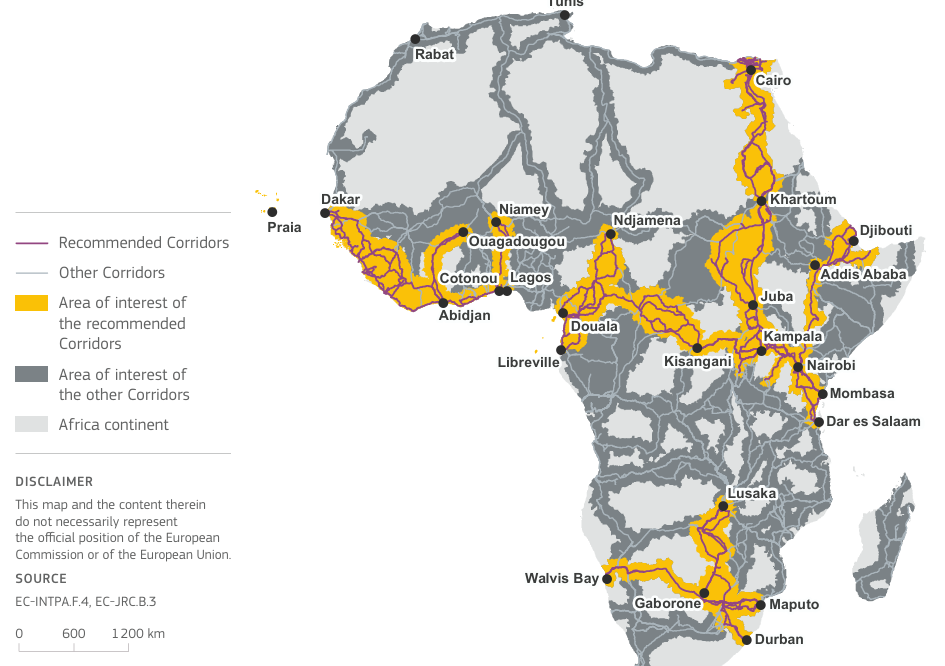
The history of the Global Gateway in Africa begins not with a summit but with a map. Before the initiative was announced, the European Commission ran a project called Corridors and Urban Systems in Africa — CUSA — which mapped the continent along its resource paths.

Carried out in two phases, the mapping narrowed an initial field of 55 potential passageways down to a shortlist of eleven strategic corridors, using 140 quantitative indicators and four policy scenarios: Europe–Africa connectivity; human development, peace and security; the Green Deal; and sustainable growth.

Some of those indicators are telling. They measured how much a region trades with the EU; the estimated availability of mineral resources; the share of each corridor projected for agriculture by 2050; World Bank versus Chinese financing between 2004 and 2014; connections between corridor ports and EU ports; and violent events and demonstrations between 2015 and January 2021.

Africa — the EU's close neighbour — is a continent full of opportunity … the EU should make the most of the political, economic and investment opportunities … through partnerships that uphold and promote European values and interests.— The CUSA Report

The corridors were evaluated against criteria defined jointly by DG INTPA and the Joint Research Centre — with no input from, or awareness by, Africa. The eleven were formally unveiled in the conclusions of the EU–African Union Summit of 17–18 February 2022.

CUSA corridor map
Mapping of the 11 corridors based on their extractive potential.
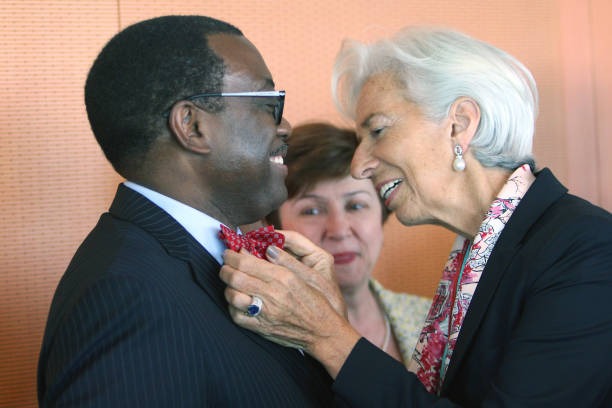
Christine Lagarde with Akinwumi Adesina, Kristalina Georgieva in the background
The financing · PGII → Team Europe

A European juggernaut, negotiating one country at a time

In 2022 the EU announced an investment package of $346.03 billion, of which $173.017 billion was earmarked for Africa between 2022 and 2027. The announcement was misleading. The G7 had just launched the Partnership for Global Infrastructure and Investment (PGII) — a repackaging of Build Back Better World — and the Gateway became Europe's contribution. PGII quickly folded in parallel national offers, including Italy's Piano Mattei (PII) for Africa. But none of the G7 actors were putting in new resources: they were repackaging existing loans and guarantees.

To exploit the leverage of individual member states, the EU adopted Team Europe — pooling political, financial and diplomatic muscle into a single wall. The consequence is an asymmetry of power: a single African country negotiates one project at a time against a European bloc of roughly $21 trillion in nominal GDP.

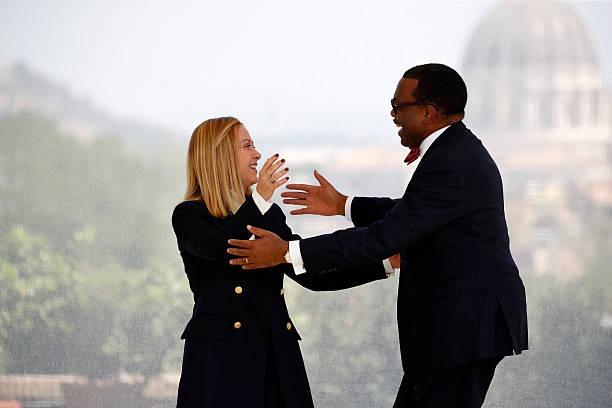
Italian Prime Minister Giorgia Meloni with African Development Bank President Akinwumi Adesina
How projects are really chosen

Ownership by consultation — with politicians only

The EU insists that every project results from long consultations with partner governments. In practice, member states bring their own projects and negotiate them with politicians — often under secrecy.

Even their own Members of Parliament recently delivered a scathing attack against the European Commission, insisting that even they (European Members of Parliament) have no oversight over Global Gateway.

Here is what 370 of them said of the Global Gateway:

The European Parliament deplores the lack of clarity and transparency regarding the funding track record and how the figure of EUR 306 billion was reached; project selection has followed an overly centralised top-down approach without sufficient involvement of stakeholders… Global Gateway is an overly Commission-driven, centralised, top-down structure limiting responsiveness to partner countries and private sector needs and weak ownership by local actors. The selection of flagship projects does not yet follow transparent criteria.European Parliament — 2026 Report on the Global Gateway

Read the full European Parliament 2026 Report on the Global Gateway →

A review of roughly 300 Global Gateway projects across Africa found not a single one debated or approved by a national parliament, or shared with citizens for public participation.

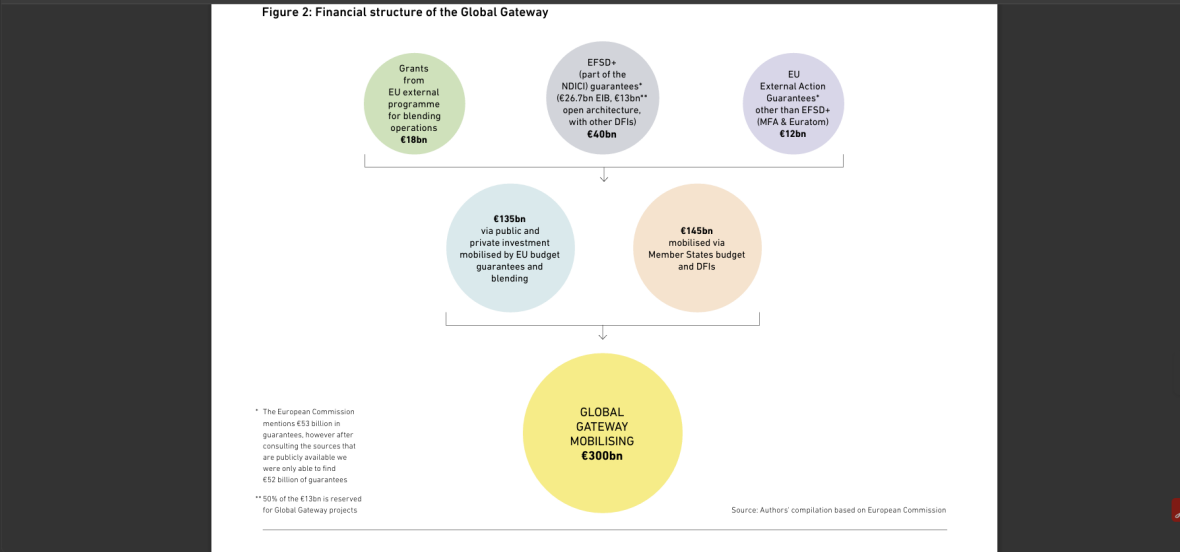
Global Gateway financial structure
Financial structure claimed to mobilise €300bn — grants, EFSD+ guarantees, and member-state DFIs. Source: Counter Balance / Eurodad / Oxfam.
Negotiations black box

Projects are negotiated individually between Team Europe and partner-country politicians, and kept confidential until a final agreement is reached — limiting scrutiny during development.

Political sensitivity

The EU avoids framing the Gateway as financial competition with China, preferring a collaborative, values-based posture that discourages financial comparison and adds to the opacity.

Illusory ownership

"Consultation" means the executive branch alone. Of roughly 300 projects reviewed, not one had been debated by a parliament or shared with citizens.

Euro-centric selection

Projects are chosen to entrench trade and investment rules that protect Europe's competitiveness — not to industrialise partner economies. Technology transfer and IP are kept off the agenda.

The hydrogen myth

The hype around green hydrogen risks increasing reliance on fossil gas. Renewables-based hydrogen production remains minimal — less than 0.1% of global hydrogen in 2022, according to Corporate Europe Observatory — and an expensive, energy-intensive solution that concentrates benefits with a handful of large companies while consuming land, water and renewable capacity that partner countries need locally.

The emphasis on green hydrogen projects, influenced by the EU Global Gateway, raises fears of exploitation and the creation of sacrifice zones.
The end game

What internal documents reveal the EU is really after

01
Change policies of third countries

This is what the EU calls the "360-degree approach": pair hard infrastructure with sectoral reforms and a regulatory environment that provides a long-term favourable policy environment to European companies.

02
Provide finance and loans

Then make sure that investment in hard infrastructure goes together with sectoral reforms. A classic case is the Vaccine initiative — used by the EU to "identify qualitative obstacles to scaling up the pharmaceutical sector," develop academic cooperation, and link up businesses through a new Business Forum.

03
Target the minds of citizens, not governments

A brand served by a new approach to strategic communication centred around campaigning to people rather than governments. A single Global Gateway brand and visual identity helps project an image of confidence, reliability and sustainability — with campaigns through local influencers in local languages.

04
Create European firepower

Team Europe means joining forces, pooling resources and combining expertise and tools. The firepower exists: the EU and its Member States account for 30% of all UN funding, 25% of the World Bank's capital, and 33% of the IMF's assets. Team Europe is also an important visibility instrument.

05
Promote European standards abroad

Going beyond funding, Team Europe should help structure normative engagement and nurture a more strategic culture of cooperation — instrumental in promoting Europe's core internal policies abroad.

06
Ringfence Africa

Africa holds 60% of the world's best solar resources and over 70% of global cobalt, yet draws only 2% of clean-energy investment. "To deliver on its geopolitical priorities, Europe needs Africa as much as Africa needs Europe."

07
Maximise impact for Europe

Show members that the EU can deliver results through flagships: vaccines in Rwanda, Senegal, Ghana and South Africa; raw-materials value chains in Zambia, DRC and Rwanda; green hydrogen in Namibia and Mauritania; and the Lobito Corridor in Angola, Zambia and DRC.

Global Gateway vs Belt & Road

Sold as China's mirror — but a different instrument entirely

China · Belt & RoadEU · Global Gateway
FundingInvestment Fund, initially projected at $4T; by 2025, China had committed over $1T in investments.Loans and Loan Guarantees, with grants primarily for de-risking. Although the EU places the value at $317B this is misleading in that it takes into account existing projects whose value is already determined.
Areas of InterestSilk Road Economic Belt and the 21st-Century Maritime Silk Road — land and sea routes across Europe, the Middle East, Central Asia, Asia and Africa.Primarily infrastructure, energy and critical-mineral initiatives following the 11 exit corridors identified by the European CUSA mapping.
Primary BeneficiaryChina — the entire belt is oriented toward moving goods and materials to China.Europe — but via "conduit" routes. With no cobalt-processing capacity of its own, materials still pass through China and Gulf states such as Qatar and the UAE.

Boston University's Chinese Loans to Africa database records 1,188 Chinese loan commitments totalling $160 billion between 2000 and 2020. Against that scale, the Global Gateway is best understood not as a separate pot of new aid, but as a reframing and consolidation of European development finance.

The strategic core

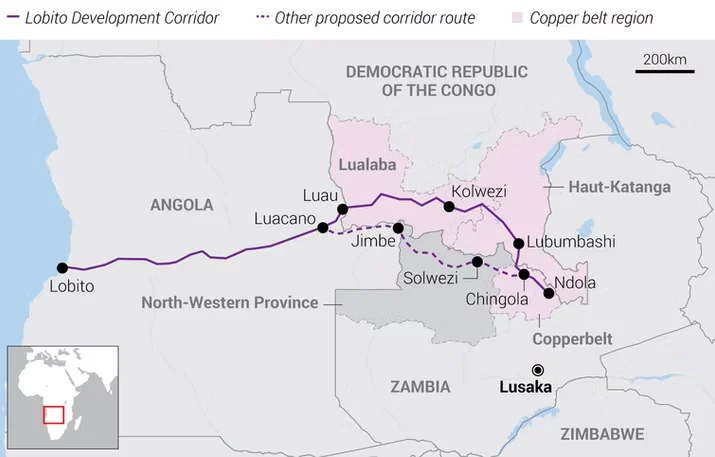
The Lobito Corridor

A classic case of how the Global Gateway deception is structured across Africa.

Chinese debt, European opportunism, Congolese blood, Angolan misrule — and a 1,300 km railway that connects foreign interests more efficiently than it connects the people who live along its tracks. It promises prosperity while delivering the same old extraction dressed in new flags, leaving a massive debt of over $400B.

Lobito is portrayed as a strategic European response to China’s expanding influence in Africa. In truth its aim is to use it as a route for transporting critical raw materials (CRMs), strategic minerals, and products of the EV battery value chain, from the DRC and Zambia, all the way to Kenya, Uganda, Tanzania, Congo Brazzaville, Mozambique and Sudan, to Europe and the US.

It secures the one thing the Global Gateway is really about: the flow of critical raw materials to Europe and America.

Read the case studies →
Lobito Corridor railway
What European leaders have said

Even the European leaders themselves agree this Berlin 2.0 partitioning of Africa is a lie and exposes the hypocrisy of European “values”

Global Gateway does not bring new financial means — there is no additional money when it comes to the EU level.
Vincent GrimaudActing Director, DG International Partnerships, European Commission
There's no new money in the Global Gateway. And I've always held the view that if there's no new money, there's no new policy. This is a communications exercise — a strategy to put together what was already going to happen and present it as something new. And if our partners are tricked by this, then more fool them.
Barry AndrewsMember of the European Parliament (Ireland), special session on the Global Gateway, 23 May 2023 · 23 May 2023